Chainsaw Cutting Techniques
Professional chainsaw operation requires more than mechanical skill—it demands understanding the physical forces acting on wood during cutting. Why do some branches drop cleanly while others pinch the bar? Why do trees react differently depending on where and how cuts are made? The answers lie in understanding how gravity, compression, and tension interact during chainsaw operations.
Arborists, landscapers, landowners, and forestry professionals who grasp these fundamental physics principles work more safely and efficiently, anticipating wood behavior rather than reacting to surprises. Whether processing storm damage, conducting tree removals, or preparing firewood, recognizing compression and tension patterns prevents equipment damage, reduces physical strain, and eliminates dangerous binding situations.
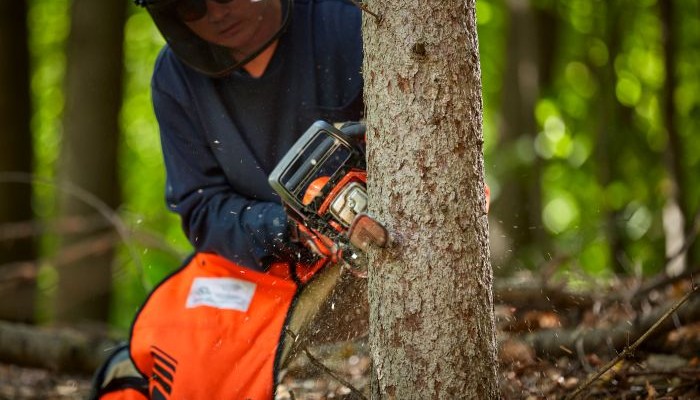
Essential Safety Equipment for Chainsaw Operations
Before examining cutting techniques, proper personal protective equipment remains non-negotiable for chainsaw work.
Complete protection includes helmet systems guarding against overhead hazards, eye protection preventing flying debris injury, hearing protection mitigating chainsaw noise exposure, chainsaw-protective chaps or pants safeguarding legs from accidental contact, and steel-toe boots providing foot protection from falling wood while ensuring secure footing on uneven terrain.
This equipment protects operators from the most common chainsaw-related injuries and should be worn consistently regardless of cut complexity or duration. Even brief chainsaw operations present significant hazard exposure that proper PPE substantially mitigates.
Gravity-Dominated Cuts: Understanding Tension at the Top
The simplest cutting scenario involves branches or logs supported at only one end, with free-hanging weight creating straightforward force distribution. When a branch extends horizontally from a trunk or when processing logs elevated off the ground with one end unsupported, gravity exerts downward force on the unsupported portion. This weight creates predictable stress patterns in the wood that determine how cuts should be executed.
In these gravity-dominated situations, the top surface of the branch or log experiences tension—the wood fibers are being pulled apart as the weight tries to bend the piece downward. Conversely, the bottom surface experiences compression as wood fibers push together, resisting the bending force. This tension-on-top, compression-on-bottom pattern is fundamental to understanding proper cutting sequence.
Proper Cutting Sequence for Gravity-Dominated Cuts
When cutting branches or logs in this configuration, starting the cut from the top would allow the weight to close the cut as sawing progresses, pinching the bar and potentially stalling the chain or causing dangerous binding. Additionally, the compression forces on the bottom can cause bark to tear away messily as the piece finally separates, creating ragged, uncontrolled breaks.
The correct approach involves:
1. Making a small undercut first—typically cutting upward from the bottom to about one-quarter to one-third of the branch diameter. This preliminary cut creates space for compression forces to act without tearing bark or binding the saw.
2. With the undercut complete, the final cut proceeds from the top downward. As this top cut progresses and nears the undercut, the tension forces cleanly separate the remaining wood fibers. The piece drops away smoothly, falling where anticipated without bark tearing or saw binding.
This two-cut technique—undercut followed by top cut—represents the standard approach for any wood under tension on top and compression on bottom. The small effort of making the initial undercut prevents the significantly larger problems of pinched bars, torn bark, and uncontrolled drops.
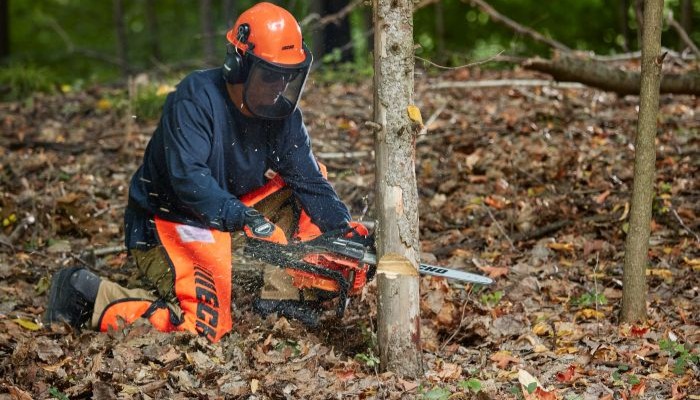
Compression-Dominated Cuts: Recognizing Supported Loads
A distinctly different force pattern emerges when cutting logs or branches supported on both ends—the classic "log over a gap" scenario. This configuration occurs frequently when processing downed trees, where the trunk rests on the ground or other obstacles at multiple points, creating unsupported spans between supports. When cutting through these unsupported sections, the wood on either side of the cut line is being pushed upward by the support points, while the wood's own weight in the middle tries to sag downward.
This configuration completely reverses the stress pattern from gravity-dominated cuts. Now the top surface experiences compression as the sagging middle pushes the top wood fibers together, while the bottom surface experiences tension as those same forces pull bottom fibers apart. Operators who fail to recognize this reversed pattern and attempt to cut these situations using the gravity-dominated technique will immediately encounter problems.
Proper Cutting Sequence for Compression-Dominated Cuts
Starting a cut from the bottom in a compression-dominated situation would result in the top closing down on the bar as soon as significant cutting progress occurred. The compression forces pushing the top together will pinch the bar firmly, potentially stalling the saw and certainly making continued cutting impossible without intervention.
The correct sequence reverses from the gravity-dominated approach:
1. Begin with a shallow top cut, opening the compression zone to relieve pressure. This cut need only penetrate about one-quarter to one-third of the log diameter—just enough to create space for the compression forces to act without closing on the bar.
2. With the compression relieved, the primary cut proceeds from the bottom upward. As this bottom cut progresses toward the preliminary top cut, the tension forces on the bottom cleanly separate the fibers.
3. The operator will observe the bottom of the cut gradually opening wider as cutting continues, indicating proper force distribution.
4. The log settles downward in a controlled manner as the remaining wood fails, resulting in a clean separation without bark tearing or saw binding.
This top-cut-first, then-bottom-cut technique is essential for safely processing logs supported on multiple points. The preliminary top cut serves the same purpose as the undercut in gravity-dominated scenarios—creating space for compression forces to act safely without compromising the cutting operation.
Visual Indicators
Experienced chainsaw operators develop the ability to read wood before cutting, identifying compression and tension zones through observation. Branches or logs elevated at one end clearly indicate gravity-dominated forces. Logs resting on the ground at multiple points with gaps between support points signal compression-dominated scenarios in those unsupported spans.
Visual cues during cutting also provide feedback about force distribution. If a cut begins to close on the bar rather than open, compression is acting on that surface—the cut should be relocated to the opposite side. If bark begins to splinter or tear around the cut, insufficient relief cut depth is allowing compression forces to overpower the wood's structural integrity. Recognizing these indicators early, before significant binding occurs, allows operators to adjust technique or add wedges before situations become problematic.
When Cuts Go Wrong: Using Wedges to Recover
Even experienced professionals occasionally misread force distribution, particularly in complex situations where multiple forces interact. When a bar becomes pinched during cutting, attempting to force the saw through or rocking it to free the bar risks equipment damage and creates kickback hazards.
The safe solution involves driving plastic or wooden wedges into the cut to forcibly open the compression zone. As the wedge is hammered into the kerf, it physically separates the wood surfaces that are pinching the bar, relieving pressure and allowing the saw to be withdrawn safely. With the wedge maintaining the opening, the operator can reassess the situation and complete the cut from the appropriate side—typically the opposite surface from where binding occurred.
Carrying several wedges when doing chainsaw work is standard practice for professionals, as they provide safe solutions to binding situations that inevitably occur when processing large volumes of wood or working in complex situations with multiple forces at play.
Applying Physics to Improve Technique
Understanding compression and tension distribution transforms chainsaw operation from trial-and-error into informed decision-making. Before starting any cut, operators should assess: Where are the support points? Which direction will gravity pull? Which surface will experience compression and which will experience tension?
These assessments take only seconds but prevent the time-consuming and potentially dangerous complications of incorrectly sequenced cuts. Wood behavior becomes predictable rather than mysterious, allowing operators to work confidently and efficiently through complex cutting scenarios. The investment in understanding these fundamental physics principles pays continuous dividends through safer operations, reduced equipment wear, and more efficient wood processing across all chainsaw applications.
Adapted from content provided by Craig from Clean Cut Yards.
Craig Willeford
Clean Cuts Yards
2023 Member
Bio:
Craig Willeford of Clean Cuts Yards is a landscaper and commercial lawncare professional in the Texas area.