Types of Fertilizer Spreaders
Understanding the different types of fertilizer spreaders available helps professionals and homeowners select the right equipment for their specific applications. From small residential projects to large-scale lawn care operations, each spreader type offers distinct advantages depending on the scope of work.
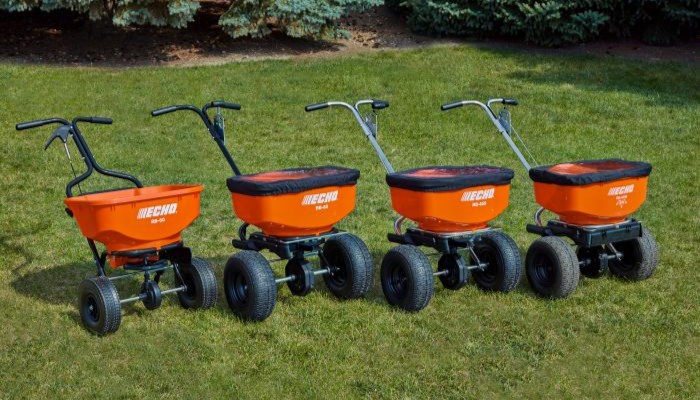
Handheld Broadcast Spreaders
The most basic option remains a time-tested solution for targeted applications. Handheld broadcast spreaders feature a simple zipper pouch design where fertilizer or grass seed is loaded, then distributed by cranking a handle that turns a spreading wheel. This manual spreader design straps over the shoulder for easy portability.
These units excel at small-scale work, making them ideal for patching bare spots or repairing small lawn areas. While they lack the capacity for large properties, their precision and affordability make them perfect for homeowners tackling occasional maintenance tasks. This design has endured for over a century because it effectively serves its niche purpose.
Push Spreaders
Push spreaders represent the next step up in capacity and convenience. Commonly found at home improvement retailers during peak lawn care season, these wheeled units eliminate the physical strain of handheld models while offering adjustable settings for different materials and application rates.
The key advantage lies in the dial-controlled spread rate, allowing operators to calibrate the unit for various fertilizers and grass seed types. However, the relatively small hopper capacity means frequent refilling when covering larger properties. These spreaders work well for homeowners with small to medium-sized yards who perform seasonal fertilization and seeding.
Mid-Capacity Tow-Behind Spreaders
For growing lawn care businesses or property managers handling multiple clients, mid-capacity tow-behind spreaders offer significant productivity improvements. These units typically feature 100-pound hoppers and attach to lawn tractors or utility vehicles, dramatically reducing application time compared to walk-behind models.
The larger tires allow for faster ground coverage, and adjustable gates control the spread width—typically 8 to 10 feet. These spreaders can handle fertilizer, grass seed, and other granular materials. However, units constructed primarily with plastic components may show wear after several seasons, particularly when exposed to corrosive materials. Gate mechanisms and adjustment systems can deteriorate, requiring periodic maintenance or repair.
Professional-Grade Stainless Steel Spreaders
The ECHO RB-85W represents the premium tier of broadcast spreaders, engineered for year-round durability and professional performance. The "W" designation indicates winter-capable construction, featuring stainless steel components specifically designed to resist rust and corrosion from salt and other harsh materials.
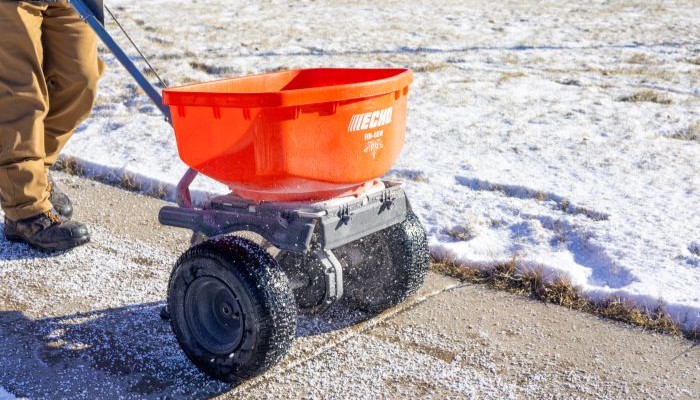
Stainless steel construction significantly extends equipment lifespan compared to plastic alternatives. The unit includes a protective hopper cover, heavy-duty tires for various terrain types, and a sophisticated four-way blocker system. This blocker allows precise control over spread direction—operators can broadcast in one, two, three, or all four directions depending on the application needs.
The adjustment system incorporates clear rate guidelines that correspond with product manufacturer recommendations, simplifying calibration. Single-finger operation makes rate changes quick and effortless during use. When properly maintained—particularly washing thoroughly after salt applications before switching to fertilizer—these professional spreaders maintain like-new condition season after season.
Selecting the Right Spreader Type
Application frequency and property size should drive equipment selection. Small residential patchwork suits handheld models perfectly. Seasonal homeowner maintenance on modest lots works well with push spreaders. Emerging lawn care professionals covering multiple properties benefit from mid-capacity tow-behind units that balance cost and capability. Established operations requiring maximum durability and year-round functionality should invest in professional-grade stainless steel equipment like the ECHO RB-85W, which delivers reliable performance and longevity that justify the initial investment.
Adapted from content provided by Nick from P & H Lawn Care.
Nick Phillips
P & H Lawn Care
2025 Member
Bio:
Nick Phillips is the owner of P&H Lawn Care, which provides landscaping and lawn care services in Tennessee.